VDI Numbers Explained: Learn Your Detector's Signals
What VDI numbers really mean, why they shift with soil and depth, and how to build your own signal history so you dig smarter and guess less.
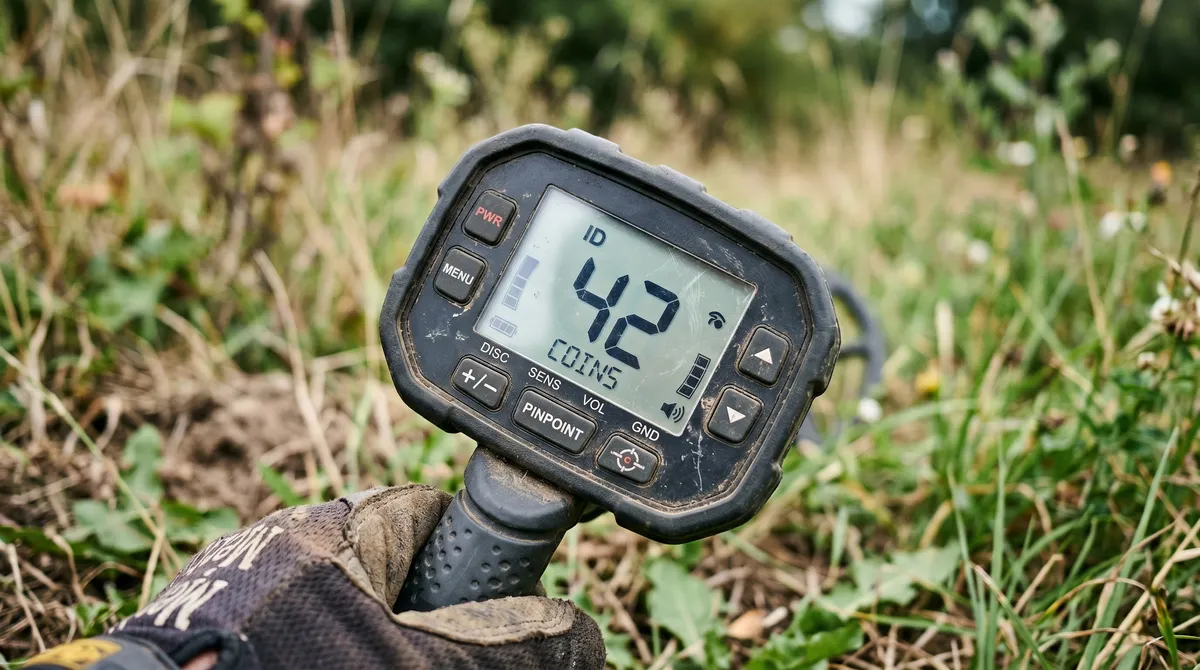
Your detector flashes “78” and you feel a little jolt of hope. But what does 78 actually mean? Sometimes a silver coin. Sometimes a big copper. Sometimes a lump of foil sitting at the wrong angle. VDI numbers are one of the most useful tools on your detector and one of the most misunderstood — so let’s get them straight.
What a VDI number actually is
VDI — Visual Discrimination Indicator, also called target ID — is your detector’s best guess at what’s under the coil, shown as a number before you dig. It works by reading how a target responds to the detector’s field. Iron and small junk respond one way, coins and silver another.
A rough, typical scale on a single-frequency detector:
| VDI range | Usually means |
|---|---|
| 1–20 | Iron, nails, hot rocks |
| 20–50 | Gold, foil, pull-tabs |
| 50–75 | Modern coins |
| 75+ | Silver, large copper |
Memorise the shape of that, not the exact numbers — because the exact numbers lie more often than you’d think.
Why the same target reads differently
Here’s the thing that trips up beginners: the same coin can show three different numbers on three different days. That’s not a fault. It’s physics. The reading shifts with:
- Depth — deeper targets read lower and jumpier.
- Soil mineralisation — heavy ground drags numbers around.
- Target angle — a coin on its edge reads nothing like one lying flat.
- Corrosion — a crusty relic doesn’t read like a clean one.
- Nearby junk — a nail next to a coin muddies the whole signal.
So treat VDI as a probability, not a promise. A solid, repeatable number from several directions is trustworthy. A number that jumps around every swing is telling you “it’s complicated down here.”
The mid-range problem
The most painful truth in detecting: gold and jewellery sit right in the junk zone. Rings, small gold, and foil all cluster in that 20–50 range. Discriminate it all out and you’ll never dig trash — but you’ll also walk over gold. There’s no setting that fixes this. The only real solution is knowing your own ground well enough to judge when a mid-range signal is worth the dig.
Build your own “personal VDI truth”
Generic charts are a starting point. Your soil is the real teacher. The detectorists who read targets best aren’t using better charts — they’ve built a personal record of what numbers mean in the ground they actually hunt.
You do that by logging, every time:
- the VDI you saw before digging,
- the metal it turned out to be,
- the depth, and
- whether it was a keeper.
Do this across enough hunts and a real picture forms. You’ll see that at one site, 64 is reliably a coin, while at a trashy park, 64 is a coin-flip. That’s knowledge no chart can give you — and it’s exactly what DetectingLog’s VDI distribution charts build for you automatically once you’ve logged your finds. Your logbook does the remembering; the charts do the pattern-spotting.
Use VDI with your other senses
VDI is one input, not the whole story. Pair it with the audio tone, the signal’s repeatability, and your pinpointer. Numbers plus tone plus consistency beats numbers alone every time. And the more you log, the more your settings choices and your target reads start to reinforce each other — which is where our detector settings guide and keeper-rate guide come in.
Frequently asked questions
What does VDI mean in metal detecting?
VDI stands for Visual Discrimination Indicator — a number your detector shows to estimate what kind of metal is under the coil before you dig. Low numbers usually mean iron, mid numbers mean gold, foil, and pull-tabs, and high numbers mean coins and silver.
Why do VDI numbers change for the same target?
Depth, soil mineralisation, the angle a target is sitting at, corrosion, and nearby junk all shift the reading. The same coin can show different numbers in different ground, which is why a VDI is an estimate, not a guarantee.
How do I learn what my detector's VDI numbers mean?
Log the VDI you saw against what you actually dug — the metal, the depth, and whether it was a keeper. After enough hunts you build a personal record of what each number tends to mean in your soil, which is far more reliable than any generic chart.
Keep reading
Metal Detecting Data: Spot Patterns Across Your Hunts
Finds per hunt, keeper rate, top locations, VDI distribution, depth bands — here is how simple stats reveal patterns your memory would miss.
Private by Default: Be Careful Sharing Detecting Locations
Why detectorists should keep their sites private — landowner trust, site preservation, theft risk — and how local-first logging protects your spots.