What to Record in a Metal Detecting Logbook
A good detecting log is a learning system, not a diary. Here is exactly what to record on every hunt so patterns and better finds follow.
A detecting log isn’t a diary of nice days out. It’s a learning system. The difference is what you choose to record — capture the right details and your log quietly tells you where to hunt, what settings to run, and how deep to dig. Capture nothing and every hunt starts from zero.
Here’s exactly what to record, and why each field earns its place.
Record these for every hunt
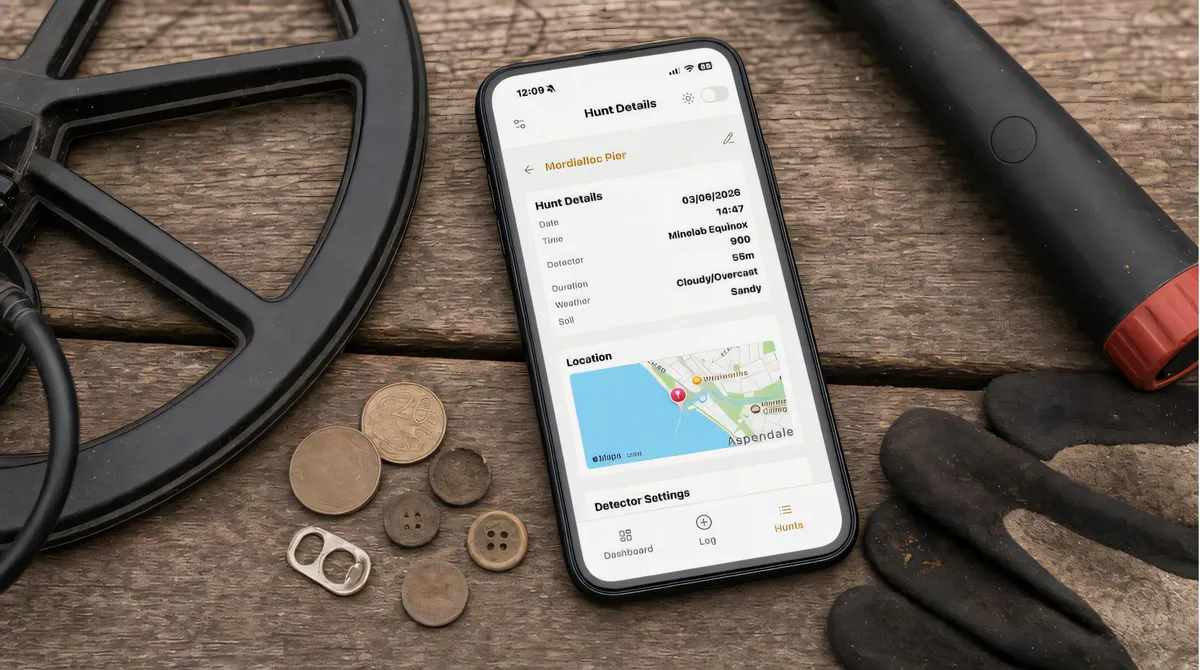
The hunt-level details set the context for everything you find that day:
- Date and time — so you can line finds up against seasons and conditions.
- GPS location — a pin beats a place name every time. Your best spot is often one corner of a big field, not the whole field. More on this in our GPS pins guide.
- Detector and settings — model, sensitivity, discrimination, and frequency mode. This is the snapshot you’ll want to repeat when a site produces.
- Duration — how long you swung. You can’t measure finds-per-hour without it.
- Weather and soil — both genuinely affect depth and signal quality. Damp ground often reads deeper than bone-dry.
- Notes — anything the data won’t capture. “Heavy iron near the gate.” “Cleaner signals after the rain.”
None of this takes long. The trick is doing it in the field, not from memory at home.
Record these for every find
The find-level details are where the real learning lives:
- Find type — coin, button, ring, relic, junk.
- Metal type — what it turned out to be.
- VDI reading — what your detector showed before you dug. Pairing the number with the actual find is how you learn your machine. See our VDI guide.
- Depth — many detectorists discover they’ve been digging too shallow once they track this.
- Keeper status — was it worth keeping, or trash? This one field powers your whole keeper-rate analysis.
- Photo — context you’ll never reconstruct later.
Yes, log the junk too. A pull-tab that read 32 is data — it teaches you what numbers to be cautious about at that site.
Why “boring” finds still matter
New detectorists often skip logging clad coins and trash because they feel unremarkable. That’s a mistake. The patterns that make you better come from volume, not from rare finds. Every logged target — keeper or not — sharpens the picture of what your detector’s signals mean in your soil. The unremarkable finds are the dataset.
Do it in the field, or it won’t happen
The single biggest reason logs fail: people put it off until they get home, and by then the details are gone. Log while you’re packing up, when the GPS pin, the depth, and the setting are all still fresh.
This is the principle DetectingLog is built around — a complete hunt entry in under a minute, fully offline, syncing later only if you want it to. No signal in the paddock? It saves locally and catches up when you’re back.
Turning a log into better hunts
Once you’ve got ten or so hunts down, the log starts paying you back:
- Best sites rise to the top — ranked by keeper rate, not gut feeling.
- Productive settings prove themselves — you’ll see which configurations pull keepers from which soil.
- Depth patterns appear — and often reveal targets you’ve been walking over.
You don’t build any of that by hand. The analytics do the aggregation; your only job is to log consistently and keep your records private.
Start with one hunt
Don’t try to backfill years of history. Just log the next hunt, then the one after. Five entries in, you’ll start noticing things. Twenty in, you’ll wonder how you ever hunted without it.
Frequently asked questions
What should I record in a metal detecting logbook?
For each hunt: the date, a GPS pin of the location, your detector and settings, the duration, weather, and soil. For each find: the type, metal, VDI reading, depth, keeper status, and a photo. That combination is what lets patterns appear over time.
Is a paper logbook or an app better for metal detecting?
Paper works, but it can't pin your GPS location, attach photos, or chart your VDI and keeper patterns later. An app captures all of that in the field in under a minute and does the analysis for you, which is the whole point of logging in the first place.
Do I really need to log every hunt?
The value compounds. One entry is a note; fifty entries are a map of what actually works for you — your best sites, your most productive settings, your depth patterns. The detectorists who improve fastest are almost always the ones who log consistently.
Keep reading
Metal Detecting Data: Spot Patterns Across Your Hunts
Finds per hunt, keeper rate, top locations, VDI distribution, depth bands — here is how simple stats reveal patterns your memory would miss.
Private by Default: Be Careful Sharing Detecting Locations
Why detectorists should keep their sites private — landowner trust, site preservation, theft risk — and how local-first logging protects your spots.