How to Document Finds with Photos, Notes, and Context
Good find records are worth more than the finds. Here is how to photograph, note, and contextualise your detecting finds — and why not to over-clean them.
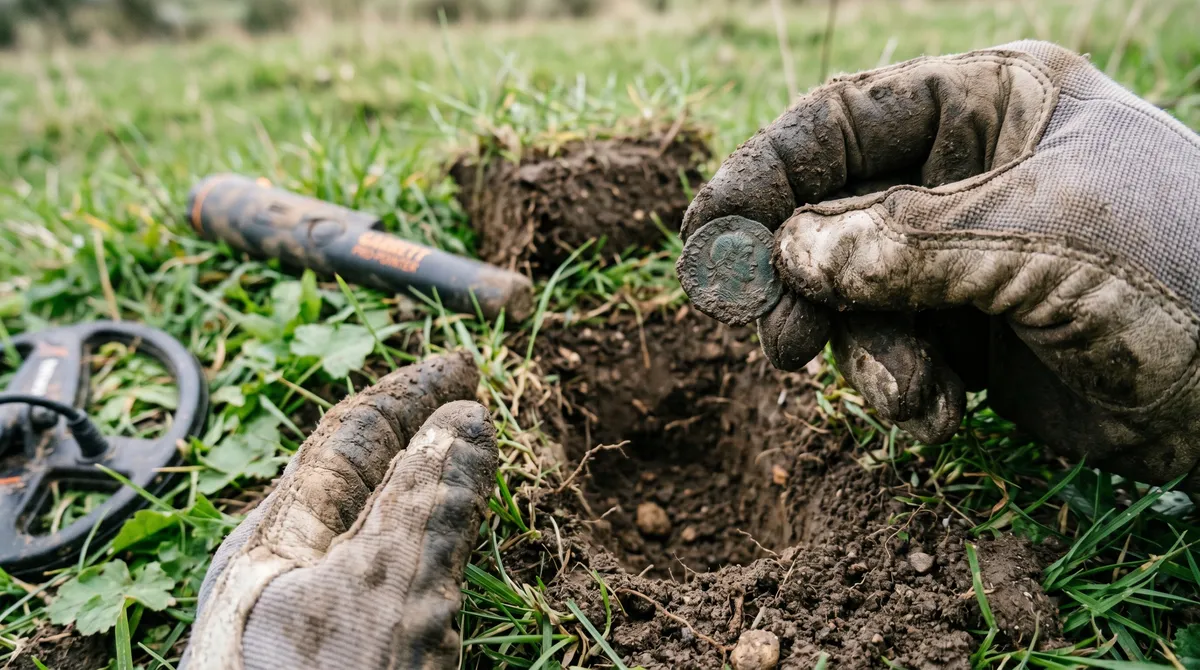
Pull a coin from the ground, glance at it, drop it in your pouch, and move on — and you’ve just thrown away most of its value. Not the coin’s value. The information’s value. The story of a find — where, how deep, in what soil, under what settings — is often worth more than the object itself. And it vanishes the moment you stop paying attention.
Here’s how to document finds so they keep paying you back.
Photograph it twice
The single best habit is two photos: one in the field, one after.
- In situ, in the field. Snap it in the hole or in your hand with the soil still on, right where you found it. This shot captures context — the ground, the depth, the moment — that you can never recreate later.
- Cleaned up, at home. Once it’s safely rinsed, take a clearer photo in good light against a plain background for identification and your records.
The field shot is the one most people skip and later wish they had. Take it first, every time.
Don’t over-clean — you can’t undo it
This matters enough to slow down for: aggressive cleaning can ruin a find. Scrubbing, polishing, and harsh chemicals strip away patina and surface detail, which can wreck both the value and your ability to identify what you’ve got. An old coin’s grime might be hiding the very detail that dates it.
So go gentle. Rinse off loose soil, pat it dry, photograph it, and research before you do anything more. If it looks old or unusual, leave it as-is and get an expert opinion. You can always clean it later. You can’t un-clean it.
Record the context that matters
A photo’s better with the details around it. For each find worth logging, capture:
- Depth — surprisingly revealing over time, and central to your keeper-rate patterns.
- VDI reading — what your detector showed before the dig, per the VDI guide.
- Soil and conditions — they explain a lot about why a find read the way it did.
- Detector settings — the snapshot that produced it.
- Notes — anything the fields don’t capture. “On its edge.” “Right against a nail.”
Tie that to a GPS pin and you’ve got a complete, private record of the find and everything around it.
Even “boring” finds are worth it
It’s tempting to only document the exciting stuff. Resist that. The clad coins, buttons, and unremarkable bits are your dataset — they teach you what your signals and settings really mean. The patterns that make you better come from volume, not rarity. Skip the ordinary finds and you starve the very analysis that improves your hunting.
Keep the story with the find
This is exactly what DetectingLog is built to do. Each find can carry its photo, depth, VDI, settings, and notes, attached to the hunt and the location — so the full story stays together instead of scattering across your camera roll and your memory. Photos are compressed to stay light, and with optional cloud sync your records (and restored photos) follow you across devices. Naturally, all of it stays private by default.
A find is a moment. A documented find is a record you’ll still be learning from years later.
Frequently asked questions
How should I photograph my metal detecting finds?
Take a shot in the field as you find it — in the hole or in hand, with the soil still on — then a cleaner photo later once it's safely rinsed. Good light and a plain background help. The in-situ shot captures context you can never recreate.
Should I clean coins and relics before identifying them?
Be careful. Aggressive cleaning can destroy detail, patina, and value, and it can make a find harder to identify. Rinse gently to remove loose soil, photograph it, and research before doing anything more. When in doubt, leave it and ask an expert.
Why record context for ordinary finds?
Because "ordinary" finds are data. The depth, location, soil, and settings behind a clad coin all feed the patterns that make you a better detectorist. Recording context turns every find — not just the rare ones — into something useful later.
Keep reading
Metal Detecting Data: Spot Patterns Across Your Hunts
Finds per hunt, keeper rate, top locations, VDI distribution, depth bands — here is how simple stats reveal patterns your memory would miss.
Private by Default: Be Careful Sharing Detecting Locations
Why detectorists should keep their sites private — landowner trust, site preservation, theft risk — and how local-first logging protects your spots.